Book Worm

Book Worm
So many books to read, so little time.

Books to read in 2018

Books to read in 2018
So many books to read, so little time.
Showing posts with label BOOKS. Show all posts

Sunday, July 29, 2018

I DARE YOU: Embrace Life with Passion by Joyce Meyer


This book has really sparked the dying passion in me. I used to really be passionate and goal-oriented when it comes to chasing my dreams. But, ever since I lost my grandparents a year ago, I have never expected the impact of losing them would make in my life. For the past year I have completely stopped chasing anything.

I used to always read about passion. How prestigious leaders tell you to pursue your passion. How self-help and career books tell about pursuing your passion so you won’t have to work every day in your life. However, this book by Joyce Meyers tells a different kind of perspective when it comes to embracing your life with passion. It incorporates the role of God in our lives.


WHAT DOES GOD WANT ME TO DO?

 As I have mentioned, I have stopped chasing anything for the past 12 months. I have literally gone tired of rejections and tired of things not going the way as I would have wanted and imagined it to be. That was the time I got really really tired of making any plans in my life. Everything was just a disappointment and contributed to my anxiety, depression and life frustrations. So what’s the point of planning? The only plan I generally make for the past year is what I was going to do 2-3 days from now.

But thanks to Joyce Meyer, she had reminded me to include God in the process of making plans in my life. It’s about time that I listen to what God really wants to say. That maybe, my previous plans never really pushed through because it isn’t what God wanted me to do. I have to learn to surrender and remind myself that it’s always His will thy will be done.

“We need to be able to celebrate each day of our lives no matter the circumstances.” - This is what Joyce Meyer tells us.

CELEBRATE EACH DAY because we are here to enjoy God and to do his will.

God has a plan and it is different from each of us. So for us to know if we are on the right track of doing His will we should learn to pray before making plans and NOT plan first and then pray that God will fulfill everything according to OUR plan. That’s not how things work. And if we keep on insisting on pushing through with our own plan, He will just keep on correcting it because HIS PLAN is always BETTER than ours.

Though it doesn’t mean we have to stop chasing our dreams. We just need to acknowledge the role of God while we chase our dreams - involve God every step of the way.

“We often get caught up in trying to work out the meaning of things and never quite accepted the fact that trusting God means we will always have unanswered questions.”

I think this is what happened to me when I came back home last year from Canada. I thought of it as God telling me to stay in the Philippines and keeping me from planning anything that involves going out of the country. But looking forward to traveling and going on a hiatus has always been my motivation in anything I plan for the long term. And not planning anything long term feels like a dead end to me. What should motivate me now? On another note, I was able to do a lot of things here in the Philippines and take on commitments since I don’t have “anything better to do” anymore.

Joyce Meyer’s motto “Ask God for anything what you want, but be content with what He gives you.”

Joyce Meyer tells us that we need to trust that God’s choice is always the best and that we won‘t always understand everything that God does. It’s like a relationship between a toddler and a parent. A toddler doesn’t understand everything that the parent does and there will be times where the parent cannot explain to their toddler why they need to do things that they do. The toddler just learns to trust the parent.

Trust that His plans are always the best. God will turn your pain into gain and your mess into a miracle.
“For I know the plans I have for you,” declares the Lord, “plans to prosper you and not to harm you, plans to give you hope and a future. Then you will call on me and come and pray to me, and I will listen to you. You will seek me and find me when you seek me with all your heart.” ‭‭Jeremiah‬ ‭29:11-13‬ ‭NIV‬‬

Tuesday, February 20, 2018

Big Bad Wolf PH Book Sale


Reflection on my visit to Big Bad Wolf PH booksale: 

The SELF-HELP section seemed to be the most sold out section! Looks like a whole lot of people need some sort of "help" ? 

Capitalism has taken advantaged of profits that they can gain from the "happiness industry."

There there... people... we don't always have to be happy all the time. Take it from the lessons in Disney's Inside Out. 

ALL our EMOTIONS are important. 

Embrace and recognize your feelings. 

Don't force yourself to be happy if you're not. 

But learn to be grateful for each day.


Friday, February 2, 2018

English & Spanish Grammar, Biology, Engineering and Psychology

What has been keeping me busy these days?

When you chose a career that is dependent on your capacity to absorb knowledge and learning, it really exhausts the mind.

I've sentenced myself to a life long learning.

In my homeschool, I have been teaching the kids English Grammar Structure & Writing, as well as, the different systems of the body (Skeletal, Muscular, Circulatory, Digestive, Respiratory and etc.).

In my personal self-learning, I try to work on my Spanish courses during my free time.

For my career and work related, I am currently writing a paper on Mechatronics Engineering and currently studying Cognitive-Behavioral Therapy for Psychology.


HAYYYY information overload!

Times like these I just really want to quit life and be a house cat.

A house cat who just sits and lay around the house, waiting for somebody to feed them, not minding other people in the house and asking for affection whenever I feel like it.

On another hand, I do enjoy what I do.

I guess this is just really a matter of life-balance.


I also need to continue reading

1) Why do nations fail? 

&

2) How to be a gentleman?

Wew... I wish I was a robot and can just scan and put a memory card in my head. 


Saturday, December 30, 2017

My E-Book Library for the incoming new year.

What's in your e-book library?


My e-book library for starting 2018. Some books I've already read and worth re-reading again. Some books I also got the hard copy because that's how much I wanted it. But having them all in one place is also soooo convenient.

I have no big plans in 2018. I just want to eat less rice and eat less sweets. And probably think less. Not to overthink, not to underthink, just... good enough thinking, good enough to keep things operational.

I guess the incoming year will be a year of less. Have less body fat. Be less extrovert. Have less friends. You know what they say, less is more. Maybe I should also talk less, yeah? XD ... Oops, never mind the latter. 😜

Currently Reading This


Saturday, December 23, 2017

Fully Booked Reading Corner


I have finished reading: Adult Children of Emotionally Immature Parents (e-book)

The books that I have put on hold are:

1) Made to Stick: Why some ideas survive and some die (e-book)
2) Learning First, Technology Second (hard copy)

Made to Stick and Learning First, Technology Second are both related to my career. Thus, I'm putting it on hold since I don't want to think too much about work related references right now.

The books below are books for self-improvement. I know I've read them before but these are books you need to read again so you get to live by it.

3) Good to Great: Why some companies make the leap and others don't (e-book)
4) How to Win Friends and Influence People (hard copy)

For leisure, I want to read a new book. This one is heavy but at the same time educational. I have an increasing interest on learning about the world lately. And I have been introducing my nephew to the world of economics. I got him a book for Christmas and I downloaded the e-book for myself. 

I'm going to stop watching netflix for a while and sit in my corner to read this book: 

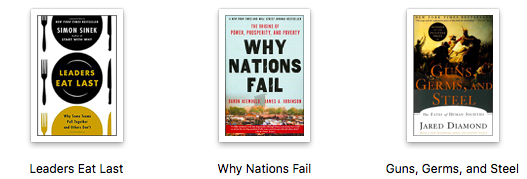
WHY NATIONS FAIL. 

Sounds like a very promising book. 


Another book that is part of my leisure chosen books is the Twisted Tales series of Disney written by Liz Braswell. It looks pretty interesting and dark. But hey, Disney!


I haven't decided what Christmas gift I'm going to treat myself with. But right now, I think I wanna start reading WHY NATIONS FAIL. 

Merry Christmas everyone!


Saturday, November 25, 2017

Guns, Germs, and Steel

"You think I'm just an ignorant savage and you've been so many places; I guess it must be so. But still I cannot see, if the savage one is me. How can there be so much that you don't know?"


A little bit segway from my usual applied psychology books is a bit of reading on history. 


The United States of America celebrated their thanksgiving last Thursday and what most people don’t realize is that while they celebrate thanksgiving holiday, there are other people who consider that holiday as the “National Day of Mourning”. If you’ve watched Disney Pocahontas, it basically shows the gist of what happened. Europeans invaded the “New World” and killed the “savages” who were currently settling there and then attempted to build a new civilization which fast forward we now refer to as US of A. 


This is quite similar to what Europeans did to the Philippines. Spain discovered our islands and named it after their King Philip, thus, Philippines. 


It made me wonder (again) why Europeans seems to have advanced faster than the rest of the world when technically we all started as cave men. 


A friend recommended that I read “Guns, Germs, and Steel” as it explains why “white societies” seemed to historically advance faster than others. It was an eye opener to me and I felt like a nerd that was able to refuel the brain with another one of life’s explanations of why things are the way things are. Oh, I’ve triggered the curious george in me. I’ve always had this question and I’ve asked this question to people numerous times but it seemed that it only made sense to me now. 


The location of the European continent was apparently “blessed” with resources that helped them produce a surplus of food in agriculture, thus, allowing the other people to pursue other “job functions”. These people, who did not farm, pursued other functions that led to technology and lifestyle advancement. In addition, the europeans were always getting into “war” with neighbouring societies and this has forced them to advance even more. 


Well, I’ll be damned.


Makes total sense now. 


"🎵 You think you own whatever land you land on. The earth is just a dead thing you can claim. But I know every rock and tree and creature, has a life, has a spirit, has a name. 🎵 "

Chapter 8: How to Avoid Getting Hooked By An Emotionally Immature Parent

I'm almost done reading the book Adult Children of Emotionally Immature Parent.

I'm already in chapter 8 and there are some notes I want to take down and quote from the chapter. 

"Although adolescence and the independence of adulthood can weaken our view of our prents as all-powerful, they don't eradicate it. Therefore, even if they aren't loving, we wishfully think they could be if they wanted to."

"A common fantasy among children of emotionally immature parents is that their parents will have a change of heart and finally love them by showing concern. Unfortunately, self-preoccupied parents refuse all invitations to fulfill their part in their child's healing story."

"Focused on their own healing fantasy, they expect their children to make up for their childhood hurts."

"In adulthood, these children often learn a variety of healthy communication skills and hope that these skills will improve their relationship with their parents. They think they might finally have the techniques necessary to draw their parents into a rewarding interaction."

"Emotional closeness demanded a level of emotional maturity her mother simply didn't have." 

"You need to find a way forward that didn't involve the parent's participation. That's the only thing that works with parents who are terrified of emotional intimacy."

"You can have a relationship with your parent but it wouldn't be the kind of relationship you yearn for. Your best option is to manage your interactions deliberately, rather than seeking emotional intimacy."

"Her mother was just passing her trauma down the line, as people tend to do when they repress their childhood pain."

"Annie was so intent on winning her mother's approval that she'd stopped evaluating the relationship. She'd never asked herself whether Betty was the type of person she enjoyed being around." 

"Annie summed up her experience of being an observer by saying that she finally figured out who her mother is and accepted her mother's personality. It's not about Annie. She didn't get sucked into how her mother is acting like the one who is hurt. She was able to separate her behavior from her sense of worth."


"Three key approaches will help you free yourself from getting caught up in your parent's emotional immaturity: DETACHED OBSERVATION, MATURITY AWARENESS, and STEPPING AWAY FROM YOUR OLD ROLE-SELF.

DETACHED OBSERVATION
"Emotionally immature parent can probably never fulfill your childhood vision of a loving parent. The only achievable goal is to act from your own true nature, not the role-self that pleases your parent. You can't win your parent over, but you can save yourself." 

"in families dominated by emotionally immature people, enmeshment and playing roles are valued in order to keep the family 'close'. Of course, genuine communication and emotional intimacy are absent in such families." 

"When interacting with emotionally immature people, you'll feel more centered if you operate from a calm, thinking perspective, rather than emotional reactivity."

"Your job is to stay detached emotionally and observe how others behave, just like a scientist would."

"If you find yourself becoming reactive, silently repeat to yourself, "Detach, detach, detach." 

"Staying observational isn't passive; it's a very active process. As you practice observing, you'll become stronger and more confident in your ability to see what's really going on, especially now that you have more of an understanding of emotional immaturity." 

Relationship versus Relatedness
"Observing allows you to stay in a state of relatedness with you parents without getting caught up in their emotional tactics and expectations about how you should be."

"Relatedness is different from relationship. In relatedness, there's communication but no goal of having a satisfying emotional exchange. You stay in contact, handle others as you need to, and have whatever interactions are tolerable without exceeding the limits that work for you."

"In contrast, engaging in a real relationship means being open and establishing emotional reciprocity. If you try this with emotionally immature people, you'll feel frustrated and invalidated."

"It makes more sense to aim for simple relatedness with emotionally immature people, saving your relationship aspirations for people who can give something back." 

There are 3 ways to relate to emotionally immature people without getting yourself upset:

1) Expressing and then letting go
2) Focusing on the outcome, not the relationship
3) Managing, not engaging

EXPRESSING AND THEN LETTING GO
"Explicitly say what you feel or want and enjoy that act of self-expression, but release any need for the other person to hear you or change. You can't force others to empathize or understand. Others may or may not respond how you want them to, but that doesn't matter. What matters is that you expressed your true thoughts and feelings in a calm and clear way.

FOCUSING ON THE OUTCOME, NOT THE RELATIONSHIP 
"Ask yourself what you're really trying to get from the other person in this interaction." 

"If your goal involves empathy or a change of heart on your parent's part, stop right there and come up with a different goal - one that's specific and achievable. Remember, you can't expect immature, emotionally phobic people to be different from how they are. However, you can set a specific goal for the interaction."

"The key is to go into the interaction always knowing the end point you with to arrive at. Focus on the outcome, not the relationship. As soon as you focus on the relationship and try to improve it or change it at an emotional level, an interaction with an emotionally immature person will deteriorate. The person will regress emotionally and attempt to control you so that you'll stop upsetting him or her."

MANAGING, NOT ENGAGING
"Instead of emotionally engaging with immature people, set a goal of managing the interaction." 

"You may need to repeatedly redirect the conversation where you want it to go."

"Emotionally immature people don't have a good strategy for countering another person's persistence. Their attempts at diversion and avoidance ultimately break down if you keep asking the same question."

CONCERNS ON THE MATURITY AWARENESS APPROACH
"If you're getting emotional, angry, or disappointed, it's best to switch over to observing objectively and managing the interaction. You aren't being cold; you're focusing on what helps you maintain emotional balance." 

"We can all get overwhelmed by another person's emotion. That's known as emotional contagion. But you'll feel more secure if you set an intention of observing what's happening, rather than becoming swept up in it. Even a bit of observation will help lift you out of the pressure to feel other's distress, not yours. You might feel some of it but you don't have to become as distressed as they are."

"Satisfying a child's physical and financial needs is not the same as meeting that child's emotional needs."

"You can't make your parents happy if they are always unhappy about something. Whatever you do, your parents don't stay happy for long. Just because they are complaining doesn't necessarily mean their goal is to feel better. That's your interpretation. Treat them nicely, but don't bleed for them. Their healing story and role-selves may require a lot of suffering and complaining. It isn't your job to abandon your own path and try to push them from behind. If you do, they're likely to become even more difficult and unpleasant." 

STEPPING OUT OF AN OLD ROLE-SELF

"The ability to step back and observe not only your parent but also your own role-self is where emotional freedom begins."

"The ultimate goal in any interaction with an emotionally immature person is to keep a grip on your own mind and feelings. To do this, you need to stay observational, noticing how you're feeling and how the other person is acting. From this perspective, you can retain your individual point of view and be more immune to the other person's emotional contagion."

"Be cautious about new openness because as a child becomes more of an individual, the emotionally immature parent's knee-jerk reaction is to do something to force the child back into an enmeshed pattern. If the child doesn't take the bait, such parents may ultimately start relating in a more genuine way. Be cautions because if your parents show uncharacteristic openness in response to your observational and goal-directed approach, they might start treating you with more respect or open up a bit, and you could be vuneravle to getting sucked back into your old healing fantasy."

"Be careful! Your inner child will always hope your parents will finally change and offer what you've always longed for. But your job is to keep your adult outlook and continue relating to them as a separate, independent adult. At this point, you're looking for an adult relationship with them, not a re-creation of parent-child dynamics."

"Your true self knows everyone involved and the reality of the situation, so it's likely to come up with exactly the response that's needed. But the only way the true self can do that is if you stay in an objective, watchful states that's grounded in your own individuality."

"Our early dependence on our parents makes us seek their love and attention. However, we must step away from our childhood roles if we don't want to repeate them in our adult relationships. The maturity awareness approach will help you deal with an emotionally immature parent or any difficult, self-involved person - more effectively."


Saturday, November 18, 2017

Recap on books I am reading...

Before I proceed with Chapter 3 of "Adult Children of Emotionally Immature Parent", I need to list down the list of "pending" books that I am simultaneously reading at the moment. As to not forget about it!

Currently Reading:

1) Adult Children of Emotionally Immature Parents (e-book)

To be continued:

1) Made to Stick: Why some ideas survive and some die (e-book)
2) Learning First, Technology Second (hard copy)

Refresher:

3) Good to Great: Why some companies make the leap and others don't (e-book)
4) How to Win Friends and Influence People (hard copy)

I guess before I go back to reading Made to Stick or Learning First, Technology Second then I should commit myself first finishing this psychology book I am reading. I need to learn how to commit.

I think it also helps if I use my blog to jot down notes or important parts of the book that I like. I need to make a review of Made to Stick & How to Win Friends and Influence People.

Both books on applied psychology.

Human behavior interests me a lot lot.


Then of course there's also "The Isle of The lost" a fictional book based on the Disney's Descendants. I haven't continued reading it, maybe when I've finished my other books!

Wew... I'm a nerd. 

Why are there so many emotionally immature parents?

Excerpts taken from Chapter 2 of "Adult Children of Emotionally Immature Parents"

Why are there so many emotionally immature parents?

"It seems that many [emotionally immature parents] never had a supportive or emotionally intimate connection with their own parents, so they developed tough defenses to survive their own emotional loneliness early in life."

"Old-school parenting was very much about children being seen but not heard."

"Parenting tended to focus on obedience as the gold standard of children's development, rather than thinking about supporting children's emotional security and individuality."

Effects of old-school parenting are passed down to children who become adults and parents of their own.

"We didn't give a damn about your feelings; we just kept a roof over your heads."

"Emotionally immature parents were once children themselves, and as children they may have had to shut down many of their deepest feelings in order to be acceptable to their own parents."

"Their personalities are like stunted bonsai trees, trained to grow in unnatural shapes. Because they had to bend to fit their families, they were unable to develop fluidly into the integrated, natural people they might have become."

Differences in Quality of Thought

"There are often intellectual difference between emotionally mature and immature people."

"If your parents grew up in a family atmosphere that was full of anxiety and judgment, they may have learned to think narrowly and resist complexity."

"Excessive childhood anxiety leads not only to emotional immaturity but also to oversimplified thinking that cannot hold opposing ideas in mind."

"Emotionally immaturity is a real phenomenon that has been studied and written about for a long time. It undermines people's ability to deal with stress and to be emotionally intimate with others."

"Emotionally immature people have an oversimplified approach to life, narrowing situations down to fit their rigid coping skills."

"Having such limited sense of self makes them egocentric and undermines their ability to be sensitive to other's people's needs and feelings."

"Their reactive emotions, lack of objectivity, and fear of emotional intimacy can make close relationships difficult, especially when it comes to their children."


Friday, November 17, 2017

Chapter 2: Recognizing the Emotionally Immature Parent

Excerpts from "Adult Children of Emotionally Immature Parents"

Chapter 2: Recognizing the Emotionally Immature Parent

"Most signs of emotional immaturity are beyond a person's conscious control, and most emotionally immature parents have no awareness of how they've affected their children."

"We aren't trying to blame these parents, but to understand why they are the way they are."

"Emotionally immature parents can have devastating impacts on their children's self-esteem and relationships in adulthood."

"Personality pattern versus Temporary emotional regression"

"Emotionally immature people don't step back and think about how their behavior impact others"

"Emotional maturity means a person is capable of thinking objectively and conceptually while sustaining deep emotional connections to others"

EMOTIONAL IMMATURE PEOPLE

They are rigid and single-minded
- "Once they form an opinion, their minds are closed."
- "There's one right answer, and they can become very defensive and humorless when people have other ideas."

They have low stress tolerance
- "Their responses are reactive and stereotyped"
- "They use coping mechanisms to deny, distort or replace reality."
- "They have trouble admitting mistakes and instead discount the facts and blame others."
- "They often overreact."

They do what feels best
- "They make decisions on the basis of what feels best in the moment and often follow the path of least resistance."

They are subjective, not objective
- "When they interpret situations, how they are feeling is more important than what is actually happening."
- "What is true doesn't matter nearly as much as what feels true."

They have little respect for differences
- "Emotionally immature people are annoyed by other people's differing thoughts and opinions, believing everyone should see things their way."

They are egocentric
- "Emotionally immature people are self-preoccupied in an obsessed way, not with the innocence of a child."
- "Young children are self-centered because they're still commanded by pure instinct, but emotionally immature adults are commanded by anxiety and insecurity."
- "Before you start feeling too sorry for them, keep in mind that their defenses work seamlessly to keep these underlying anxieties below the level of awareness. They would never see themselves as being insecure or defensive."

They are self-preoccupied and self-involved
- "They're constantly monitoring whether their needs are being met or whether something has offended them."
- "Their self-esteem rises or falls depending on how others react to them."
- "Because their self-involvement is all-consuming, other people's feelings are eclipsed by their needs."
- They are profoundly self-involved because their development was stunted by anxiety during childhood.

They are self-referential, not self-reflective
- "Emotionally immature people are highly self-referential, meaning that in any interaction, all roads lead back to them."
- "Their focus on themselves isn't about gaining insights or self-understanding; it's about being the center of attention."
- "As you talk to them, self-referential people will turn whatever you say back to one of their own experiences."
- "Those who are more socially skilled might listen more politely, but still won't hold their interest. They may not overtly change the subject, but they won't ask follow-up questions or express curiosity about the details of your experience.
- "Because they lack self-reflection, emotionally immature people don't consider their role in a problem."
- "Their egocentric focus remains on their intention, not the impact on you."

They like to be the center of attention
- "In groups, the most emotionally immature person often dominates the group's time and energy."
- "You may wonder whether these people are just being extroverted. The difference if that most extroverts easily follow a change of topic. Because extroverts crave interaction, not just an audience, they're interested and receptive when others participate."

They promote role reversal
- "The parent relates to the child as if the child were the parent, expecting attentiveness and comfort from the child."
- " These parents may reverse roles and expect for their child to be their confidant, even for adult matters."
- "Parents who discuss their marriage problems with their children are an example of this kind of reversal."

They have low empathy and are emotionally insensitive.
- "Impaired empathy is a central characteristic of emotionally immature people, as is avoidance of emotional sharing and intimacy."
- "They are strikingly blind to how they make other feel."
- "True empathy involves more than knowing what people feel; it also entails the ability to resonate with those feelings."
- "In spite of not resonating empathically, [emotionally immature people] are often quite canny when it comes to reading other people's intentions and feelings"

They are often inconsistent and contradictory
- "Emotionally immature people are like amalgam of various borrowed parts, many of which don't go together well. Because they had to shut down important parts of themselves out of fear of their parent's reactions, their personalities formed in isolated clumps, like pieces of puzzle that don't fit together."
- "Their personalities are weakly structured, and they often express contradictory emotions and behaviors."
- "They step in and out of emotional states, never noticing their inconsistency. When they become parents, these traits create emotional bafflement in their children."
- "Emotionally immature people may be either loving or detached, depending on their mood."
- "Intermittent reward situation: Meaning that getting a reward for your efforts is possible but completely unpredictable. This creates a tenacious resolve to keep trying to get the reward, because once in a while these efforts do pay off."
- "Parental inconsistency can be the quality that binds children most closely to their parent, as they keep hoping to get that infrequent and elusive positive response."
- "Since a parent's response provides a child's emotional compass for self-worth, such children also are likely to believe that their parent's changing moods are somehow their fault."

They develop strong defense that take the place of the self
- "Emotionally immature people learn during childhood  that certain feelings were bad and forbidden."
- "Not realizing the magnitude of their parents' developmental limitations, many children of emotionally immature people think there must be a genuine, fully developed person hiding inside the parent."
"But when people's defenses have become an integral part of their personality, they're as real as a scar tissue in the body. It may not have belonged there originally, but once formed, it's enduring."
- "Whether they can ultimately become more authentic and emotionally available, depends on their ability to self-reflect."
- "Unfortunately, if their parents aren't interested in noticing their impacts on others, they have no impetus to look at themselves, without self-reflection, there's no way to change."

They fear feelings
- "As children, many emotionally immature people grew up in homes where they were taught that the spontaneous expression of certain feelings was a shameful breach of family custom."
- "As a result, they anxiously sought to inhibit their genuine reactions, developing defensive behaviors instead of experiencing their true feelings and impulses."
- "Affect phobia can lead to an inflexible, narrow personality based on rigid defenses against certain feelings. As adults, these emotionally immature people have an automatic anxiety reaction when it comes to deep emotional connection."
- "As parents, they pass down this fear of vulnerable emotions to their children."
- "Many children of emotionally phobic parents develop the fear that if they start crying, they'll never stop, which arises because they were never allowed to find out that crying naturally stops on its own when allowed its full expression."
- "Even positive feelings of joy and excitement can become associated with anxiety."

They focus on physical instead of emotional
-"Emotionally immature parents can do a good job of taking care of their children's physical and material needs.
- "But when it comes to emotional matters, they can be oblivious to their children's needs."
- "Being well cared for in non-emotional areas can create confusion in people who grow up feeling emotionally lonely. They have overwhelming physical evidence that their parents loved and sacrificed for them, but they feel a painful lack of emotional security and closeness with their parents."

They can be killjoys
- "Fear of genuine emotion can cause emotionally immature people to be killjoys."
- "As parents, instead of enjoying their children's excitement and enthusiasm, they may abruptly change the subject or warn them not to get their hopes up."
- "In response to their children's exuberance, they're likely to say something dismissive or skeptical to bring it down a notch."

They have intense but shallow emotions
- "Emotionally immature people are easily overwhelmed by deep emotion, and they display their uneasiness by transmuting it into quick reactivity."
- "Their reactivity may seem to indicate that they're passionate and deeply emotional, but their emotional expression often has a glancing quality, almost like a stone skipping the surface rather than going into the depths."
- "When interacting with such people, the weirdly shallow quality of their emotions may leave you feeling unmoved by their distress."
- "Because they overreact so frequently, you may quickly learn to tune them out for the sake of your own emotional survival."

They don't experience mixed emotions
- "The ability to feel mixed emotions is a sign of maturity."
- "If people can blend contradictory emotions together, such as happiness with guilt, or anger with love, it shows that they can encompass life's emotional complexity."
- "The reactions of emotionally immature people tend to be black-and-white, with no gray areas. This rules out ambivalence, dilemmas, and other emotionally complicated experiences."

Difficulties with conceptual thinking
- "As children enter their teen years, their ability to self-reflect skyrockets because they become able to think about their own thinking. However, the intense emotions and anxiety that emotionally immature people experience can decrease their ability to think at this higher level."
- "Frequent lack of self-reflection comes from the tendency to regress and temporarily lose their ability to think about their thinking."
- "Emotionally immature people who are otherwise intelligent can think conceptually and show insight as long as they don't feel too threatened in the moment."

Proneness to literal thinking
- "If you listen to the conversations of emotionally immature people, you may notice how routine and literal their thinking is."
- "Emotionally immature people tend to talk about what happened or what they observed, not the world of feelings or ideas."

Intellectualizing obsessively
- "Overintellectualizing and getting obsessed about certain topics is a cognitive sign of emotional immature people."
- "Their preocuppation with ideas distracts them from emotional intimacy. They may discuss their favorite topics at length, but they don't really engage the other person."
- "Although they can think conceptually while communicating their ideas, they're only comfortable if things stay on an impersonal and intellectual level."

Done reading Chapter 2! 


Wednesday, November 15, 2017

Reading: Adult Children of Emotionally Immature Parents

Important excerpts from the book that I want to remember:

CHAPTER 1: How Emotionally Immature Parents Affect Their Children's Lives.

"Emotional neglect in childhood leads to a painful emotional loneliness that can have a long-term negative impact on a person's choices regarding relationships and intimate partners."

"Emotionally immature parents fear genuine emotion and pull back from emotional closeness. They use coping mechanism that resist reality rather than dealing with it. They don't welcome self-reflection, so they rarely accept blame or apologize. Their immaturity makes them inconsistent and emotionally unreliable, and they're blind to their children's needs once their own agenda comes into play."

Fairytales 

Children = abandoned and seek aid from other people

Parents = careless, clueless or absent

"Children must take their survival into their own hands" 

"By grasping the concept of emotional immaturity, you can develop more realistic expectations of other people, accepting the level of relationship possible with them instead of feeling hurt by their lack of response."

"The loneliness of feeling unseen by others is a fundamental a pain as physical injury, but it doesn't show on the outside. Emotional loneliness is a vague and private experience, not easy to see or describer. You might all it a feeling of emptiness or being alone in the world. Some people have called this feeling existential loneliness but there's nothing existential about it. If you feel it, it came from your family."

"When the children of emotionally immature parents grow up, the core emptiness remains, even if they have a superficially normal adult life. Their loneliness can continue into adulthood if they unwittingly choose relationships that can't give them enough emotional connection."

"You might have thought that feeling empty and alone was your own private, strange experience, something that made you different from other people. As a child, you have no way of knowing that this hollow feeling is a normal, universal response to lacking adequate human companionship."

"Once you start listening to your emotions instead of shutting them down, they will guide you toward an authentic connection with others. Knowing the cause of your emotional loneliness is the first step toward finding more fulfilling relationships."

"Lacking adequate parental support or connection, many emotionally deprived children are eager to leave childhood behind. They perceive that the best solution is to grow up quickly and become self-sufficient. These children become competent beyond their years but lonely at their core."

"Classic confusion of a person whose physical needs were met in childhood while emotional needs remained unfulfilled. [They] often feel guilty for complaining. Men and Women alike will list the things they have to be thankful for, as if their life were an addition problem whose positive sum means nothing can be wrong. But they can't shake the feeling of being fundamentally alone and lacking the level of emotional intimacy they crave in their closes relationships."

"Emotionally disconnected parents don't suddenly develop a capacity for empathy just because a child does something to please them."

"Emotional connection is a basic human need, regardless of gender."

"People who lacked emotional engagement in childhood, men and women alike, often can't believe that someone would want to have a relationship with them just because of who they are. They believe that if they want closeness, they must play a role that always puts the other person first."

"Feeling trapped in taking care of parents"

"Their experiences with their parents have taught them that relationships mean feeling abandoned and burdened at the same time. To these people, relationships feel like traps."

"Fortunately [she] summoned the strength to establish her own independent life. In the process, she discovered that guilt was a manageable emotion, and a small price to pay for her freedom."

"Not until she was nearly fifty did she begin to understand how her relationship with her mother fueled her underlying feelings of anxiety. That was one of the most meaningful discoveries of her life."

"A lack of emotional intimacy creates emotional loneliness in both children and adults."

"Even adult success doesn't completely erase the effects of parental disconnection earlier in life."

"Understanding how your parent's emotional immaturity has affected you is the best way to avoid repeating the past in you adult relationships."

Finally done with Chapter one! 

This book totally talks about how childhood trauma can affect us in adulthood. The book's approach is more on psychodynamic theory on personalities. I think I need to go through my theories of personality notes and read again about psychodynamic psychologists. 

From the unconscious to the subconscious and out in the surface of the conscious. 


Saturday, October 14, 2017

Why is it taking me so long to finish this damn book.

I'm investing a lot of my time finishing this book that I've been wanting to finish for ages. 

For a book that wants to teach people how to make ideas that stick, this book is sure quite lengthy.

I'm not sure if it's practicing what it preaches and how are they sure the ideas that they want to convey are going to stick to the reader when this book is just so damn long to read.

The only thing that's keeping me interested in wanting to finish the book is the "Knowledge Gap" as coincidentally they are explaining in the current chapter I'm reading on. 


Well in summary, the book explains in the introduction that there are 6 principles to remember when trying to generate ideas that "stick" to people's minds. 

S-imple
U-nexpected
C-oncreteness
C-redibility
E-motions
S-tories


Well, here's to me hoping that I remember all those principles.

I still have 3 more books to focus on. How to win friends and influence people, Good to Great & Learning first Technology Second. 

This is me just trying to make my brain bigger by stuffing in a lot of information.

I hope I also don't forget to practice my Spanish. I only have 2 more months before I renew my 1 year subscription to Babbel again. 


Wednesday, October 11, 2017

Books I'm Reading

I'm trying to juggle my time where I can practice my Spanish and at the same time be able to read the books I want to read.

Wow, look at me... I sound like a book worm. Whereas I remember the days when I hated reading. But eventually I realized I hated reading because I haven't really discovered the things that you can learn from books.

Currently I'm reading Made To Stick and Learning First, Tecunology Second.


I actually remember that I started reading Good To Great and How To Make Fruends and Influence People, but I never got to absorb everything it said.


So now I'm deciding I'm going to juggle reading these 4 books.

I like reading books where I learn things... and most of them are actually related to things that I can apply on how I live my life. I guess that's why my degree is psychology. I like studying human behavior and I am constantly reflecting on my own behavior and trying to improve myself.

There are actually a lot of things I want to happen in my life right now but most of them are out of my control. So might as well focus on the things I can control and try not to waste too much of my time on things that are not really an investment (like playing Fall Out Shelter or Binge Watching TV series)

This post is a reminder to read

1) Made to Stick: Why some ideas survive and others die
2) Learning First, Technology Second: The Educator's Guide to Designing Authentic Lessons
3) Good To Great: Why some companies make the leap.. and others don't
4) How to make friends and Influence People

Focus focus focus gotta finish them all!

Saturday, March 25, 2017

Mi Libros En Español Que Me Ayuda Practicar Mi Español

I will need to have actual conversations in Spanish before I learn how to Speak and Listen, naturally. But I guess learning how to Read and Write in Spanish is a good start for me in learning a third language. 

I'm still a beginner but it amazes me when I skim through a page and read words in Spanish that I can actually understand what was written. I may not be able to interpret them word per word but the context clues already build images in my head. I think that's how reading a heavy material works anyway. We read using context clues. 


It feels so exciting! I haven't been excited like this for many weeks now. Probably because I haven't really had set myself personal goals as of late. I've been taking my Babbel courses but some days it tires me because it feels completely just studying and just that. But reading books in Spanish is more than just studying the language but the stories I read, it makes me feel so alive. 


"We don't read and write poetry because it's cute. We read and write poetry because we are members of the human race. And the human race is filled with passion. And medicine, law, business, engineering, these are noble pursuits and necessary to sustain life. But poetry, beauty, romance, love, these are what we stay alive for. " - Dead Poet's Society

Wednesday, March 22, 2017

Cómo gana amigos e influir sobre las personas.

I got the Spanish version of one of my favorite books "How to make friends and influence people" by Dale Carnegie.

I figured that I haven't finished re-reading it because I always feel like I prefer finishing my Spanish lessons. So I realized that maybe I can hit two birds with one stone by reading the Spanish version of the book. I'll be able to read the book again and develop my Spanish vocabulary. Sure it will probably take me a long time to finish this one but heck... two birds.


Monday, July 11, 2016

48 Laws of Power by Robert Green

Here's a screen shot of my current iBooks in my Macbook. I can't wait to have free time so I can go back reading to these books again. These are type of books that you have to read more than once. I just realized that most of my favorite books are on the lines of learning the art of manipulation. Isn't applied psychology just awesome? lol ... anyway... not that I want to manipulate anybody... I just want to learn human behavior and how the best way to behave in certain situations... *wink*


Anywayyyyy... the only book that I haven't read in my collection is 48 Laws of Power. I cam across an article from Business Insider (http://www.businessinsider.com/robert-greene-tips-on-becoming-more-powerful-2015-3?op=1) and read the summary of each "Law" ... Kinda deceptive but it's like the "Art of War" but only different, somehow.. Anyway it does sound interesting.. I'm sharing here the clippings from the article I mentioned. And then after completing my thesis revisions I will 1) Study Spanish and 2) Read my books!


Funny that when I was a child I hated reading books. It just completely bores me. If only I was introduced to these "behavioral" books then maybe I could have developed the love of manipulation, or I mean, the love of psychology and reading at an early age! ... Human behavior is just so awesome.